
Bitcoin halving is one of the most important events in cryptocurrency. It happens roughly every four years and cuts the reward miners get for validating transactions in half. With the next halving approaching, investors and market watchers are paying attention to what it might mean for prices and network security. If you’re looking at cryptocurrency investments, understanding how this works matters.
What Is Bitcoin Halving?
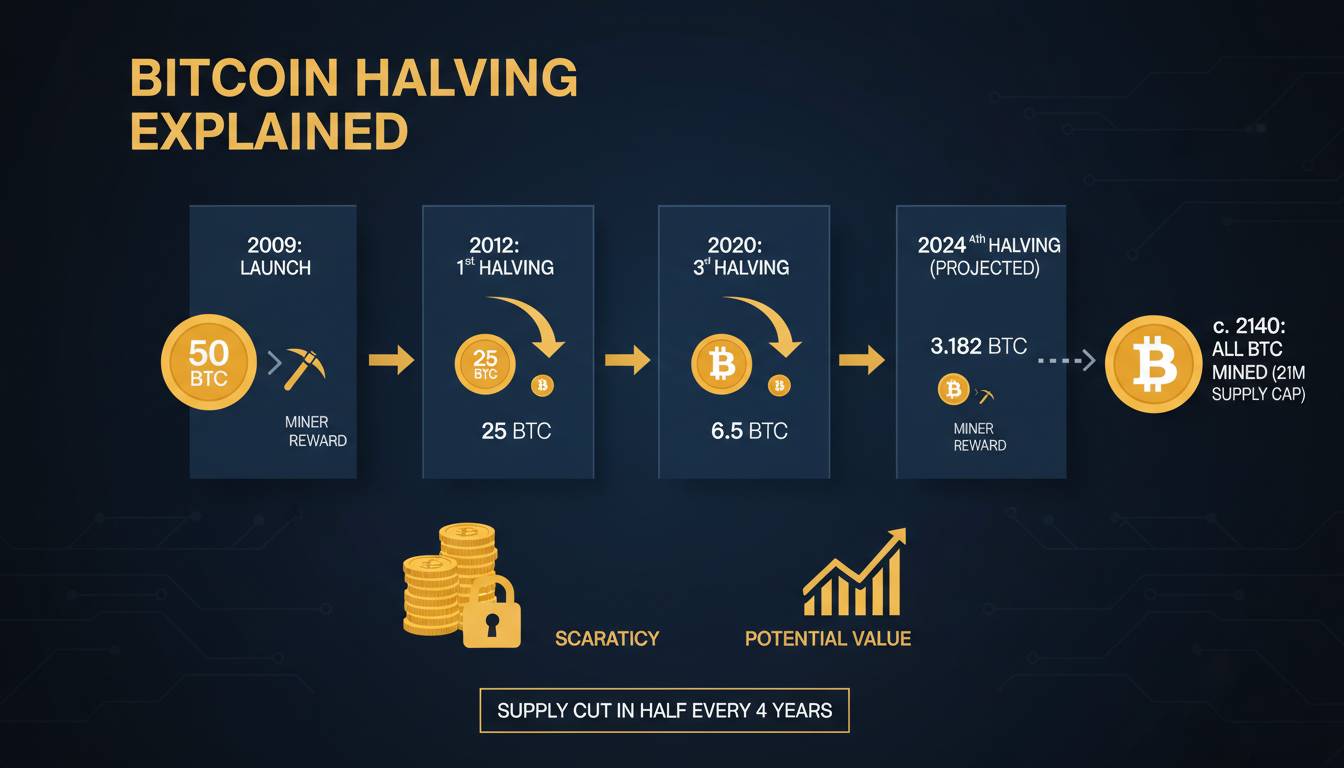
Bitcoin’s code automatically cuts the miner’s block reward in half every 210,000 blocks—about every four years. When Bitcoin started in 2009, miners earned 50 BTC per block. That dropped to 25 BTC in 2012, then 12.5 BTC in 2016, and 6.25 BTC in 2020. The most recent halving happened in April 2024, bringing the reward down to 3.125 BTC.
This mechanism exists because Bitcoin has a hard cap of 21 million coins. Unlike fiat currencies that governments can print endlessly, Bitcoin’s supply is fixed. The halving slows how fast new coins enter circulation. Around 2140, all 21 million Bitcoin will be mined, and no new coins will come after that.
Why Does Bitcoin Halving Occur?
Satoshi Nakamoto built this into the system to prevent inflation—basically to make Bitcoin work something like gold. In the 2009 whitepaper, Satoshi designed a money system that no government could manipulate. The halving makes new Bitcoin appear slower over time, creating a predictable monetary policy baked into the code itself.
This is fundamentally different from traditional money. Central banks can print more whenever they want. Bitcoin can’t. The halving means less new supply hitting the market, which—if demand stays steady—should push prices up.
The technical side is straightforward: the code runs automatically. No company, government, or person can change the schedule. That’s the point.
The Impact on Bitcoin Miners
Miners keep Bitcoin running. They use specialized hardware to solve math problems, validate transactions, add blocks to the chain, and earn the block reward. When that reward halves, their income drops—sometimes dramatically.
Historically, some miners get pushed out when this happens, especially those with expensive electricity or outdated equipment. The more efficient operations survive. The network’s hash rate sometimes dips temporarily, but the difficulty adjustment usually sorts things out within a few weeks.
The pressure has pushed mining tech forward fast. Companies have poured billions into better ASIC miners—machines that hash more while using less power. Where mining happens has shifted too, moving toward places with cheap renewable energy: Texas, Iceland, parts of China before the crackdown.
Historical Price Performance and Market Cycles
Looking at past halvings, there’s a pattern worth knowing about—though past performance doesn’t guarantee anything.
After the 2012 halving, Bitcoin went from about $12 to nearly $1,100 over the next year. The 2016 halving preceded a run to almost $20,000 by late 2017. The 2020 halving came before the peak of nearly $69,000 in November 2021.
But the connection isn’t instant. Sometimes it takes months or even years for prices to move significantly after a halving. And every big rally has been followed by a crash—sometimes a brutal one.
One thing that does compound: after enough halvings, the percentage increase in total supply gets tiny. This is why some people are bullish long-term. Critics will rightly say demand matters just as much as supply.
The Halving and Bitcoin’s Long-Term Utility
The halving reinforces what makes Bitcoin different from other cryptos. Many altcoins have inflationary tokenomics—new tokens keep getting created. Bitcoin doesn’t work that way.
This scarcity angle has drawn in institutional investors and companies looking for alternatives to gold or treasury bonds. Whether you think that’s warranted or overblown, it’s clearly a major part of Bitcoin’s appeal.
One evolution to watch: as block rewards shrink, transaction fees become more important for miners. Eventually, fees will be the only reward. How that plays out for network security is one of the bigger open questions.
Regulatory and Global Considerations
The regulatory picture varies wildly depending on where you are. In the US, things remain murky—the SEC and CFTC can’t seem to agree on whether Bitcoin is a security or a commodity. That uncertainty affects how institutions engage with it.
Globally, it’s a patchwork. El Salvador made Bitcoin legal tender. China cracked down hard. Some countries welcome it; others restrict or ban it. The halving’s economic impact won’t look the same everywhere—it depends on local rules, energy costs, and how integrated crypto is into the financial system.
International bodies are working on frameworks, which could shift how halving events move markets going forward.
The Technical Mechanism Behind Halving
The how is actually pretty simple. Bitcoin’s blockchain adjusts mining difficulty every 2,016 blocks—roughly every two weeks—to keep block times around ten minutes regardless of how much total hash power is on the network.
The halving itself is hard-coded. When a block hits height divisible by 210,000, the reward drops automatically. There’s no human approval needed. Changing it would require a hard fork that the network would almost certainly reject.
Full nodes enforce the rules. Miners compete for rewards. Wallet users sign transactions. No one group controls the schedule.
What to Expect in Future Halving Events
Future halvings will have less impact on absolute supply reduction as we get closer to 21 million. The reward gets tiny—a fraction of a Bitcoin. Transaction fees matter more and more.
The last halving happens around 2140, when the reward hits zero and miners survive purely on fees. How that works long-term is still being figured out.
Each halving will keep getting media attention and market speculation. If you’re investing, a long-term view helps. The halving is baked into Bitcoin’s design—it’s not a surprise or a gimmick.
Frequently Asked Questions
When is the next Bitcoin halving?
Expect it around 2028, roughly four years after April 2024. The exact date varies because block times aren’t perfectly steady, but it’s close to every four years.
Does Bitcoin halving always cause price increases?
Historically, yes—but that’s not a promise. Price depends on sentiment, regulation, macro conditions, and tech changes. Some halvings have been followed by long price stagnations before anything happened.
How does halving affect regular Bitcoin users?
Mostly through transaction fees and confirmation times. If demand is high, fees go up. The reduced inflation is theoretically good for holders since each Bitcoin becomes scarcer.
Can Bitcoin’s halving be changed or stopped?
Only through a hard fork that the majority of the network would adopt. Given how decentralized and entrenched Bitcoin is, this is extremely unlikely. The fixed supply is a feature, not a bug—and the community treats it that way.
What happens after all Bitcoin is mined?
Sometime around 2140, the last satoshi gets mined. After that, miners rely entirely on transaction fees. It’s a big unknown how that affects security long-term.
Should I buy Bitcoin before or after the halving?
Timing the market around this is notoriously hard. Dollar-cost averaging tends to work better than trying to guess the top or bottom. Only invest what you can afford to lose, and don’t put all your eggs in one basket.