
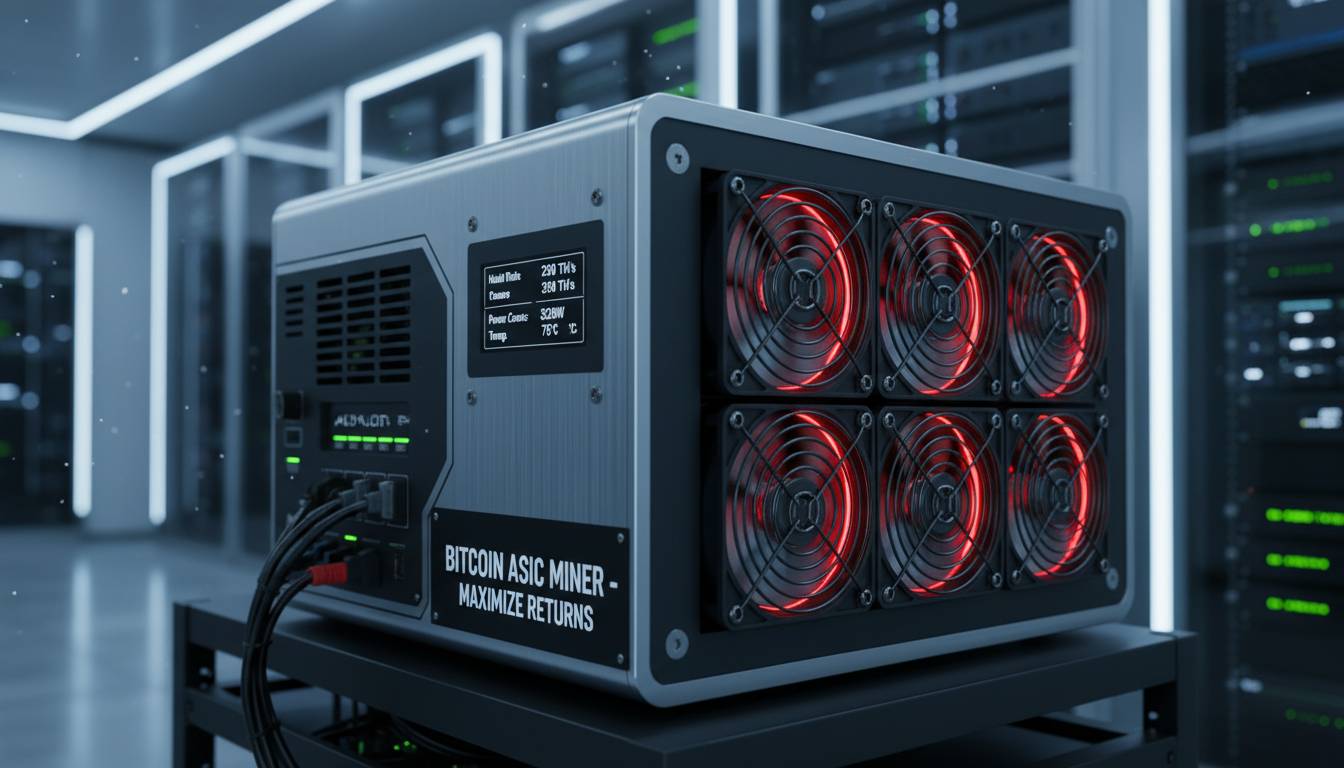
The Bitcoin mining landscape in 2024 is complicated. Following the April 2024 halving, which cut block rewards from 6.25 BTC to 3.125 BTC, profitability dynamics shifted across the global mining ecosystem. Bitcoin’s price has shown resilience, reaching levels not seen in previous cycles, but rising network difficulty, variable electricity costs, and increasingly sophisticated hardware requirements create a challenging environment where success depends on strategic decision-making.
Understanding Bitcoin Mining Profitability in 2024
Profitability equals revenue from block rewards and transaction fees minus operational costs—electricity, hardware depreciation, pool fees, and maintenance. You calculate daily revenue based on your hash rate contribution to the network, then subtract costs to find your net profit.
The industry has matured. Amateur operations increasingly struggle against institutional-scale competitors. Network difficulty exceeded 80 trillion hashes per second in late 2024, meaning only the most efficient operations maintain sustainable profit margins. The protocol adjusts difficulty every two weeks to keep blocks solving at roughly ten minutes, so as more miners join, each miner’s share of rewards decreases.
According to CoinGecko, the profitability window for individual miners narrowed after the halving. Break-even electricity costs now require locations where power stays below $0.08 per kilowatt-hour when using modern hardware like the Antminer S21. This is a real challenge for miners in high-cost utility regions.
Key Factors Affecting Mining Returns
Several variables determine whether Bitcoin mining operations generate profits, with electricity costs being the biggest operational expense. Hardware efficiency, measured in joules per terahash (J/TH), directly impacts electricity consumption relative to computational output. The most efficient miners in 2024 use about 15-20 joules per terahash. Older models need 40-60 joules per terahash—a threefold difference in energy costs for the same hash rate.
Bitcoin’s price is the primary revenue driver. When BTC trades above $60,000, as it has for much of 2024, even moderately efficient operations can turn a profit. Price drops below key support levels immediately compress margins or make operations unprofitable. Mining profitability calculations must account for volatility—conservative planning assumes BTC falls 30-40% from current levels.
Network hash rate and difficulty adjust roughly every two weeks, responding to total computational power dedicated to mining. The April 2024 halving created immediate pressure: revenue per block dropped 50% while difficulty kept climbing. Marginally profitable operations before the halving found themselves losing money, triggering hashrate migration and equipment retirement that temporarily adjusted network dynamics before equilibrium returned.
Electricity Costs and Geographic Advantages
Geographic location is the most critical variable. Electricity costs vary by factors of five or more between cheapest and most expensive regions.
In the United States, parts of Texas, Washington, and Montana offer industrial rates between $0.04 and $0.08 per kilowatt-hour, making viable operating environments for large-scale mining facilities. Some operations secure even lower rates through direct partnerships with energy providers or by locating at abandoned industrial sites with existing power infrastructure.
Internationally, the disparities are stark. Russia, Kazakhstan, and parts of the Middle East offer electricity below $0.03 per kilowatt-hour in certain regions, though these locations have their own challenges—regulatory uncertainty, infrastructure limitations, geopolitical risks. Miners in Germany, Japan, or high-cost energy markets face significant disadvantages, with electricity sometimes exceeding $0.20 per kilowatt-hour, making profitable Bitcoin production nearly impossible.
Curtailment agreements, where miners temporarily reduce operations during peak grid demand in exchange for lower rates, have become common. This demand-response approach lets miners access preferential pricing while helping utilities manage load. Texas has become a hub for these arrangements, with ERCOT facilitating mining participation in demand response programs.
Hardware Selection and ROI Considerations
Choosing mining hardware means balancing upfront capital costs against operational efficiency and expected lifespan. Newer, more efficient equipment typically wins despite higher purchase prices. Leading ASIC miners from Bitmain, MicroBT, and Canaan offer different price points and efficiency ratings, letting operators tailor purchases to their electricity costs and scale needs.
The Antminer S21 series, released in late 2023 and widely deployed in 2024, approaches 15 joules per terahash. These machines cost $2,500 to $4,000 depending on batch and availability, but deliver operational savings that usually result in faster ROI. Older generations like the Antminer S9 have largely become obsolete for profitable operations unless electricity costs are exceptionally low.
ROI calculations for 2024 hardware must account for hardware depreciation as models become less competitive, maintenance adding 5-10% to operational costs, pool fees typically 1-3% of rewards, and hardware resale value at the end of the mining lifecycle. Conservative projections assuming stable Bitcoin prices suggest payback periods of 18-30 months for efficient hardware in low-cost electricity environments, though adverse conditions extend these timelines significantly.
The Impact of the 2024 Halving Event
The April 2024 halving was Bitcoin’s fourth, reducing the block reward from 6.25 BTC to 3.125 BTC and fundamentally changing profitability for all network participants. This programmed reduction occurs roughly every four years, serving Bitcoin’s deflationary monetary policy by decreasing new supply entering circulation. For miners, the halving immediately cut revenue per unit of computational work in half.
Market reaction was unexpected—Bitcoin’s price climbed in the months following the halving rather than declining. This appreciation helped offset roughly half the revenue reduction from the halved block reward. Miners who had prepared financially were better positioned to maintain operations. The price increase reflected broader market sentiment around Bitcoin’s fixed supply schedule and increased institutional adoption.
The hashrate landscape restructured significantly. Less efficient operators exited while larger players with better economics continued or expanded. Network hash rate initially declined 10-15% in weeks after the halving before recovering to new highs as survivors optimized and newer hardware deployed. This consolidation accelerated the professionalization of mining, with publicly traded companies and institutional operators increasingly dominating network participation.
Strategies for Maximizing Mining Returns in 2024
Maximizing profitability requires a multi-faceted approach. First, secure the lowest possible electricity costs through long-term power purchase agreements, renewable energy installations, or geographic relocation. The difference between $0.03 and $0.10 per kilowatt-hour can mean the difference between profit and loss.
Pool participation is critical. Mining pools aggregate computational resources for more consistent rewards while reducing income variance. Major pools including Foundry USA, AntPool, and ViaBTC dominate the network, offering fee structures from 1% to 4% with various payment methodologies. FPPS (full pay-per-share) provides more predictable returns by covering transaction fees regardless of actual network activity. Choose based on your operational scale and risk tolerance.
Tax optimization strategies, while not directly increasing revenue, significantly impact net returns. In the United States, miners may benefit from equipment depreciation deductions, business expense classifications for operational costs, and potentially energy-related tax incentives. Consulting tax professionals specializing in cryptocurrency operations yields substantial savings.
Future Outlook and Industry Projections
Bitcoin mining profitability will continue evolving based on Bitcoin’s market price, network difficulty progression, and the energy landscape. Difficulty will likely continue climbing as more efficient hardware enters the network and existing operators expand, requiring ongoing attention to efficiency. The 2028 halving will further challenge miner economics.
The regulatory environment keeps developing. Several jurisdictions consider or implement frameworks specifically addressing cryptocurrency mining. These regulations create compliance costs but also provide legitimacy and potentially open new markets for miners who navigate the legal landscape. Environmental concerns drive particular regulatory attention, making renewable energy-powered operations increasingly advantageous from both operational and compliance perspectives.
Technological advancement in mining hardware continues. Manufacturers develop next-generation chips promising further efficiency improvements. These developments will push the industry toward professional, large-scale operations capable of justifying capital investments in state-of-the-art equipment. Individual miners or smaller operations increasingly need access to exceptionally cheap electricity, willingness to operate at minimal margins, or participation in alternative consensus mechanisms or mining pools with more favorable economics.
Conclusion
Bitcoin mining profitability in 2024 is complex—post-halving revenue compression, unprecedented network difficulty, and the critical importance of electricity cost management. The industry has matured and barriers to profitable operation have increased, but well-positioned miners with efficient hardware and low-cost power can still achieve meaningful returns, especially given Bitcoin’s continued market strength.
Success requires ongoing attention to operational efficiency, strategic planning around hardware investments and energy procurement, and adaptability to evolving regulatory and market conditions. The fundamental economics remain attractive for those with appropriate capital reserves, realistic expectations, and operational discipline. As the network grows and Bitcoin’s role in the global financial system evolves, mining will likely remain viable for participants who manage the variables within their control while adapting to those beyond their influence.
Frequently Asked Questions
Is Bitcoin mining still profitable in 2024?
Yes, for operations with efficient hardware and electricity costs below approximately $0.08 per kilowatt-hour. The April 2024 halving reduced block rewards to 3.125 BTC, but Bitcoin’s price appreciation has offset much of this revenue reduction. Profitability varies significantly by location, hardware efficiency, and operational scale.
How much do Bitcoin miners earn per day in 2024?
Daily earnings depend on hash rate contribution and electricity costs. A modern Antminer S21 with 200 TH/s capability generates roughly $10-20 per day in revenue at current Bitcoin prices, varying with network difficulty and transaction fees. After electricity costs at average U.S. rates, net daily profit typically ranges from $3-12 depending on local power prices.
What is the most profitable Bitcoin mining hardware for 2024?
The Antminer S21 series (15-17 J/TH), MicroBT’s WhatsMiner M60 series (16-18 J/TH), and Canaan’s Avalon Made 1566. These models offer the best balance of hash rate output and power consumption for maximizing profitability in current conditions.
How has the 2024 Bitcoin halving affected mining profitability?
The April 2024 halving immediately reduced mining revenue per block by 50%, squeezing margins for higher-cost operations. Some less efficient miners exited, but Bitcoin’s subsequent price appreciation helped stabilize overall industry profitability. Those with efficient hardware and cheap electricity have generally maintained positive returns, though the competitive landscape intensified.
What electricity cost is needed for profitable Bitcoin mining in 2024?
Profitable mining typically requires electricity below $0.08 per kilowatt-hour with modern, efficient hardware. Operations with power costs between $0.03-$0.05 per kWh have significant competitive advantages. Those paying above $0.12 per kWh generally struggle to achieve sustainable profitability without exceptional hardware efficiency or alternative energy access.
How do I calculate my Bitcoin mining profitability?
Determine your hash rate in TH/s, multiply by your portion of the current network block reward, divide by total network hash rate to find daily BTC revenue, multiply by current Bitcoin price for USD revenue, then subtract daily electricity costs (watts used × 24 hours × electricity rate per kWh). Online calculators from WhatToMine and CryptoCompare simplify this with real-time data.