
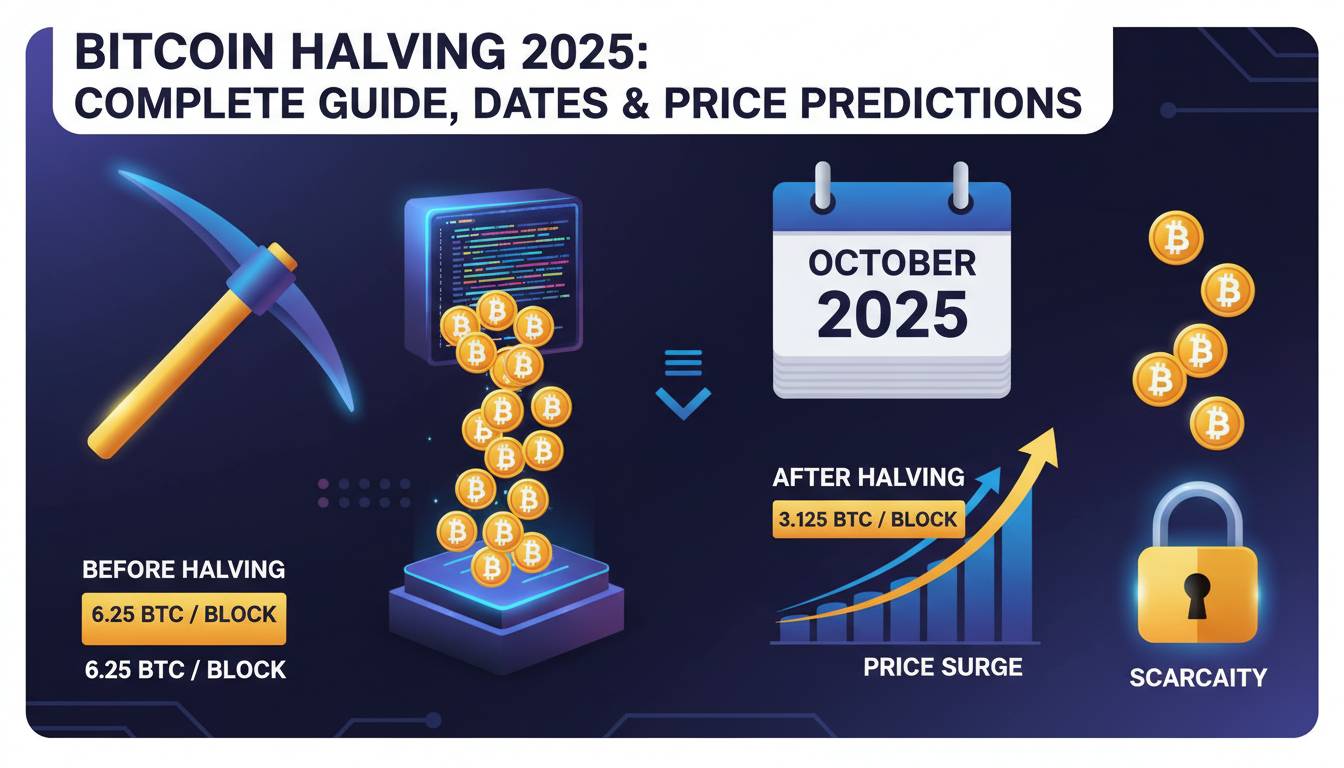
The Bitcoin halving scheduled for April 2025 is drawing attention from investors, miners, and analysts across the cryptocurrency space. This programmed reduction in the block reward has historically influenced market dynamics, though the relationship between halvings and price movements is more nuanced than simple supply-side economics. This guide covers what you need to know about the technical mechanics, historical context, and potential implications for the market.
What Is Bitcoin Halving and How Does It Work
Bitcoin halving is built into Bitcoin’s code by its creator Satoshi Nakamoto. Every 210,000 blocks (roughly four years), the reward miners get for adding new blocks gets cut in half. This is Bitcoin’s way of controlling inflation—only 21 million coins will ever exist.
Once a halving happens, miners earn fewer new bitcoins for their work. The new supply entering circulation drops. This scarcity mechanism has historically pushed prices up, though the connection between halvings and price isn’t straightforward—lots of other things matter too.
Bitcoin runs on proof-of-work. Miners solve math puzzles to validate transactions and keep the network running. The block reward pays them for securing the network and brings new bitcoins into the world. As rewards shrink over time, transaction fees will eventually become the main way miners get paid. The network will need to handle that shift as block rewards eventually hit zero.
Historical Context: Previous Bitcoin Halvings
Looking at past halvings gives a sense of how the market has behaved around these events.
The first halving happened in November 2012, when the reward dropped from 50 to 25 BTC. Back then Bitcoin traded around $12 and was still pretty niche. Over the next year, the price climbed to nearly $1,000.
The second halving came in July 2016, cutting the reward to 12.5 BTC with Bitcoin around $650. The market exploded afterward, reaching almost $20,000 by December 2017. It showed how halvings can spark major price surges, though the exact reasons why are still debated.
The third halving hit in May 2020, reducing the reward to 6.25 BTC when Bitcoin was near $8,800. The following two years were wild—Bitcoin peaked at $69,000 in November 2021 before crashing hard. This proves halvings often come before big moves, but regulation, macro conditions, and market sentiment all shape what actually happens.
Bitcoin Halving 2025: Expected Date and Technical Details
The 2025 halving is expected in April 2025, though the exact date depends on block times and network hashrate. The event triggers when block height 840,000 is reached.
When it happens, the block reward drops from 6.25 to 3.125 BTC. That’s roughly 450 BTC entering daily instead of 900—millions less supply hitting the market each day at current prices.
About 19.6 million BTC exist already, leaving roughly 1.4 million to mine before hitting the 21 million ceiling. The 2025 halving pushes toward that limit, with more halvings scheduled roughly every four years until around 2140 when the last fractions get minted and block rewards vanish.
Network difficulty retargets every 2,016 blocks (roughly two weeks) to keep blocks coming every 10 minutes no matter how much mining power shifts. This keeps the network stable and predictable.
Market Expectations and Price Predictions
People have different views on what might happen to prices around the 2025 halving. Some analysts think reduced supply could push prices higher if demand holds steady. Others note that past performance doesn’t guarantee future results.
Institutional adoption has changed the market. The Bitcoin ETFs approved in early 2024 gave traditional finance easier access to Bitcoin. This shifted the market structure and might change how halvings affect prices compared to earlier cycles.
Trading volumes in Bitcoin futures and options have risen, showing more interest from both retail and institutional players. But crypto is volatile, and history doesn’t always repeat.
Impact on Bitcoin Miners and the Network
Miners face a tough situation with the halving. Their revenue gets cut in half overnight, so they need to either cut costs, boost efficiency, or rely more on transaction fees to stay afloat. This has historically led to consolidation as smaller miners get squeezed out.
Bitcoin mining uses a lot of energy, and regulators and environmental groups have noticed. Mining operations are increasingly moving to areas with cheap renewable energy and investing in carbon offsets. The economic pressure from halvings might speed up this shift toward greener practices.
Network security depends on miners staying profitable enough to keep working. As block rewards shrink, transaction fees matter more for keeping the hash rate up. Developers are thinking about how to maintain security as rewards keep dropping toward zero.
Difficulty adjustments help balance things out. When mining becomes less profitable, some miners drop out, difficulty falls, and the remaining miners can earn more. This self-correcting mechanism has kept the network stable through multiple halvings.
Regulatory Landscape and Institutional Adoption
Bitcoin regulation varies wildly around the world. Some countries ban it outright, others embrace it, and most are somewhere in between trying to protect consumers while not killing innovation.
The SEC approved Bitcoin spot ETFs in January 2024—a big deal for mainstream adoption. These let investors get Bitcoin exposure through regular brokerage accounts without dealing with custody. The money flowing into these products has changed market dynamics.
Central bank digital currencies are another factor. While they’re nothing like Bitcoin, CBDC projects have prompted discussions about decentralized money’s place in the financial system.
Tax rules for crypto are a mess and vary by country. If you’re trading Bitcoin around the halving, talk to a tax pro to avoid surprises.
Investment Considerations and Risk Factors
Crypto is volatile. Past halvings have sometimes led to price gains, but that doesn’t mean they always will. Don’t invest money you can’t afford to lose.
Diversification is key. Bitcoin might go up a lot, but it should only be part of a balanced portfolio. How much depends on your age, risk tolerance, and goals.
Security matters. Use a hardware wallet, keep your private keys safe, and back everything up. Once crypto is gone, it’s gone forever.
Trying to time the market is a losing game. Most people who try to buy before a halving and sell after end up worse off than just buying regularly and holding.
Conclusion
The 2025 halving is a significant moment in Bitcoin’s monetary policy. As the network approaches its fourth reward reduction, participants are watching the market while dealing with an evolving regulatory environment.
The link between halvings and prices involves many factors beyond just supply. Macro conditions, regulation, tech changes, and market mood all play a role. Historical patterns might suggest potential gains, but treat them as possibilities, not certainties.
Rather than trying to guess short-term price moves, focus on understanding what you’re investing in and managing your risk. Bitcoin has survived multiple halvings and will keep evolving. Its next chapter will shape crypto for years to come.
Frequently Asked Questions
When exactly will the Bitcoin halving 2025 occur?
The expected date is April 2025, though it depends on block times. The halving triggers when block height 840,000 is reached, cutting the block reward from 6.25 BTC to 3.125 BTC.
What happens to Bitcoin’s price after the halving?
Past halvings have coincided with major price runups, but nothing’s guaranteed. Price depends on sentiment, regulation, institutional adoption, and broader economic conditions.
Will Bitcoin miners be affected by the halving?
Yes—miners earn 50% fewer new bitcoins per block. They’ll need better efficiency or more fee revenue to stay profitable, which often leads to industry consolidation.
How many times has Bitcoin halved before?
Three times: 2012, 2016, and 2020. The 2025 halving will be the fourth.
Does the halving make Bitcoin more valuable?
The reduced supply could create upward pressure if demand holds or grows. But plenty of other factors determine price too.
Should I buy Bitcoin before the 2025 halving?
Make that decision based on your own finances and risk tolerance, not on event speculation. Talk to a financial advisor if you’re unsure.