
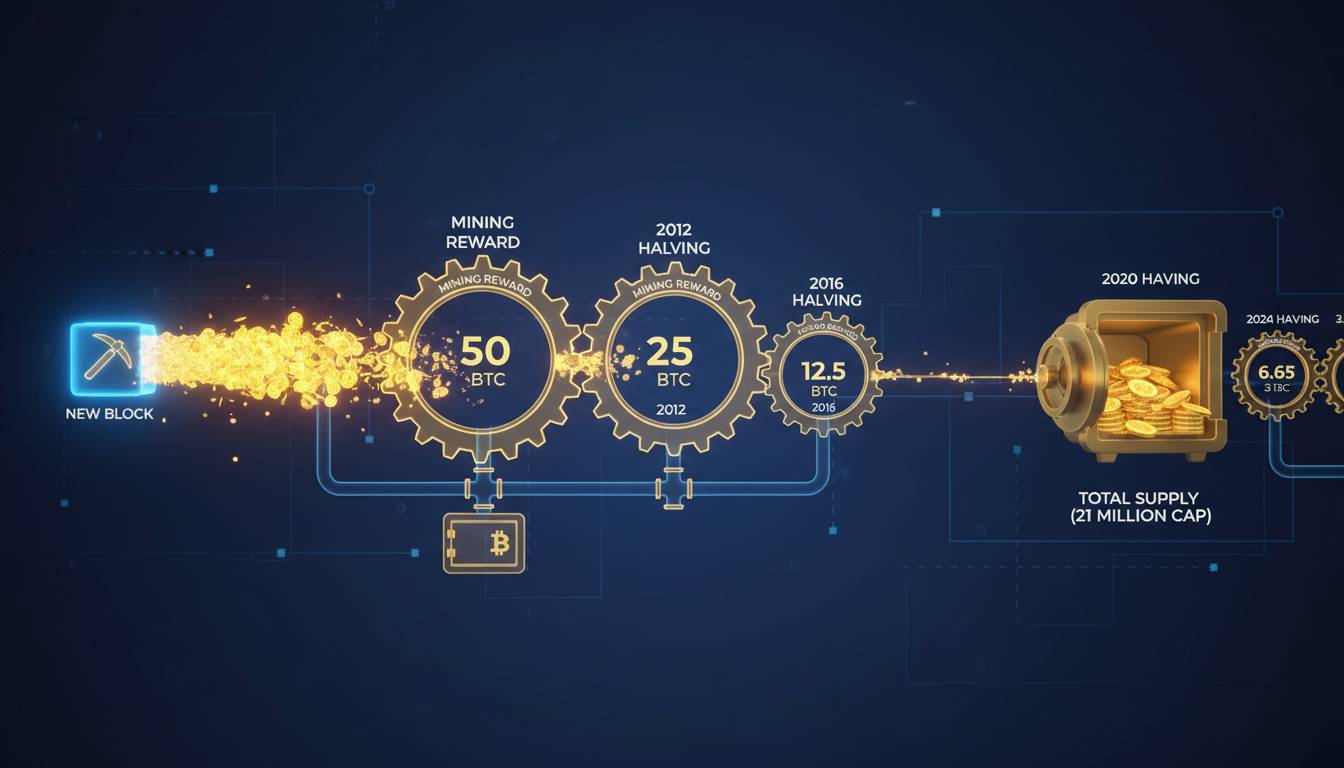
The Bitcoin halving is one of the most predictable events in crypto, happening roughly every four years and cutting miner rewards in half. The 2024 version dropped the block reward from 6.25 BTC to 3.125 BTC, and as always, everyone’s arguing about what it means for prices.
This guide covers what halving actually is, what happened in previous events, and what might come next.
What is Bitcoin Halving?
Bitcoin’s code automatically cuts the miner reward by 50% every 210,000 blocks—roughly four years. It’s built into the system to slowly phase out new Bitcoin issuance until the 21 million supply is maxed out. The comparison to gold mining isn’t accidental; the goal is scarcity through controlled supply.
When Bitcoin launched in 2009, miners got 50 BTC per block. That dropped to 25 BTC in 2012, then 12.5 in 2016, and 6.25 in 2020. After April 2024, it’s 3.125. By that point, about 19.6 million BTC had already been mined—roughly 93% of everything that will ever exist. The last satoshi won’t drop until around 2140.
This mechanism keeps Bitcoin’s supply strictly capped, which is the whole point. No central bank can print more.
Bitcoin Halving History
Looking at past halvings gives you something to point at, though each cycle is different.
2012: First halving, block 210,000. Reward dropped from 50 to 25 BTC. Price went from about $12 to over $1,000 by late 2013. But this was also when crypto started getting real attention, so it’s not clean evidence.
2016: Second halving, block 420,000. Reward at 12.5 BTC. Price climbed to nearly $20,000 by December 2017—the ICO boom era. Again, lots of other stuff was happening.
2020: Third halving, block 630,000. Reward became 6.25 BTC. This preceded the big run to $64,000 in 2021. Unprecedented monetary stimulus and institutional money piling in had just as much to do with it as the reduced supply.
The pattern looks nice on charts. But 2012 was post-financial crisis, 2016-2017 was the ICO mania, 2020 was money-printing season. Different drivers each time.
Bitcoin Halving 2024: Date and Block Reward
April 19, 2024, block 840,000. Reward dropped to 3.125 BTC. Exactly as programmed.
At that point, 19.6 million of the 21 million total had been mined. The remaining 1.4 million will take over a century to release through the halving schedule.
No user action required—the network just adjusts automatically. Miners feel it immediately in their revenue.
What Happens After Halving?
Miners get half the revenue but same costs. Some operations shut down temporarily. Hash rate drops, then recovers as efficiency improves. That’s been the pattern.
The supply side is straightforward: daily new Bitcoin drops from roughly 900 to 450. Less new stuff hitting the market. Whether that moves prices depends on demand, which has other drivers.
Volatility usually picks up. Traders position for moves in both directions.
Market Implications
Reduced rewards shift miner revenue toward transaction fees, which changes how users think about fees and confirmation speed. Layer-two solutions matter more when base-layer costs matter more.
The big difference for 2024: spot Bitcoin ETFs got approved in the US. That’s institutional access on rails—regulated exposure without custody headaches. This wasn’t available in previous halvings.
Macroeconomics matter too. Interest rates, fiscal policy, how people think about “safe” assets—all of it intersects with crypto sentiment. The 2024 halving landed in a environment where everyone’s still figuring out what “normal” looks like post-stimulus.
Frequently Asked Questions
What is Bitcoin halving?
A programmed event that cuts miner rewards by 50% roughly every four years. Keeps total supply capped at 21 million.
When did the Bitcoin halving 2024 occur?
April 19, 2024, at block 840,000. Reward dropped from 6.25 to 3.125 BTC.
How does halving affect price?
Historically prices went up, but there were always other factors at play. Reduced supply issuance + steady demand could push prices up, but nothing’s guaranteed.
What happens to miners after halving?
Revenue gets cut in half. Some operations become unprofitable and shut down. Efficiency improvements and consolidation follow.
How much Bitcoin has been mined?
About 19.6 million BTC as of 2024—93% of the eventual 21 million.
Will prices go up?
History says maybe, but past performance doesn’t guarantee future results. Adoption, regulation, macro conditions—all matter.
Conclusion
The halving is baked into Bitcoin’s design. It’s predictable, it’s deflationary, and it’s the main thing that makes Bitcoin different from currencies that can be printed indefinitely.
The 2024 version landed in an unusual spot: reduced supply, but now with ETFs creating new demand channels. Whether that combination pushes prices higher is the question everyone wants answered.
We won’t know for sure until it plays out.