
Crypto mining in 2024 is a different beast than it was even two years ago. Bitcoin’s network difficulty keeps climbing, the halving cut block rewards in half, and electricity prices haven’t gone down anywhere. Picking the right hardware matters more now than it ever has—if you buy the wrong rig, you might never break even.
This guide looks at what’s actually worth buying this year. I’ll cover ASICs, GPU rigs, and the math behind why some machines make money and others become expensive space heaters.
Understanding Crypto Mining Hardware Fundamentals
Before you look at specific models, you need to understand the numbers that actually matter.
Hash rate is how fast a miner can guess solutions to the math problems that validate blockchain transactions. For Bitcoin ASICs, this is measured in terahashes per second (TH/s). Higher hash rate means more guesses per second means more chances at block rewards. Simple enough.
Power efficiency is joules per terahash (J/TH). This tells you how much electricity each unit of hash rate burns through. This metric matters more now than it did a few years ago, because electricity costs money and difficulty keeps going up. A machine that uses 20 J/TH will eat your profits alive at $0.12/kWh.
The actual profitability calculation isn’t complicated: daily revenue minus electricity cost equals your profit. But people get tripped up when they forget that network difficulty increases over time. That rig you bought might make $10/day today and $3/day in a year.
Top ASIC Miners for 2024
The ASIC market is essentially a two-horse race: Bitmain and MicroBT. Everyone else is fighting for the scraps.
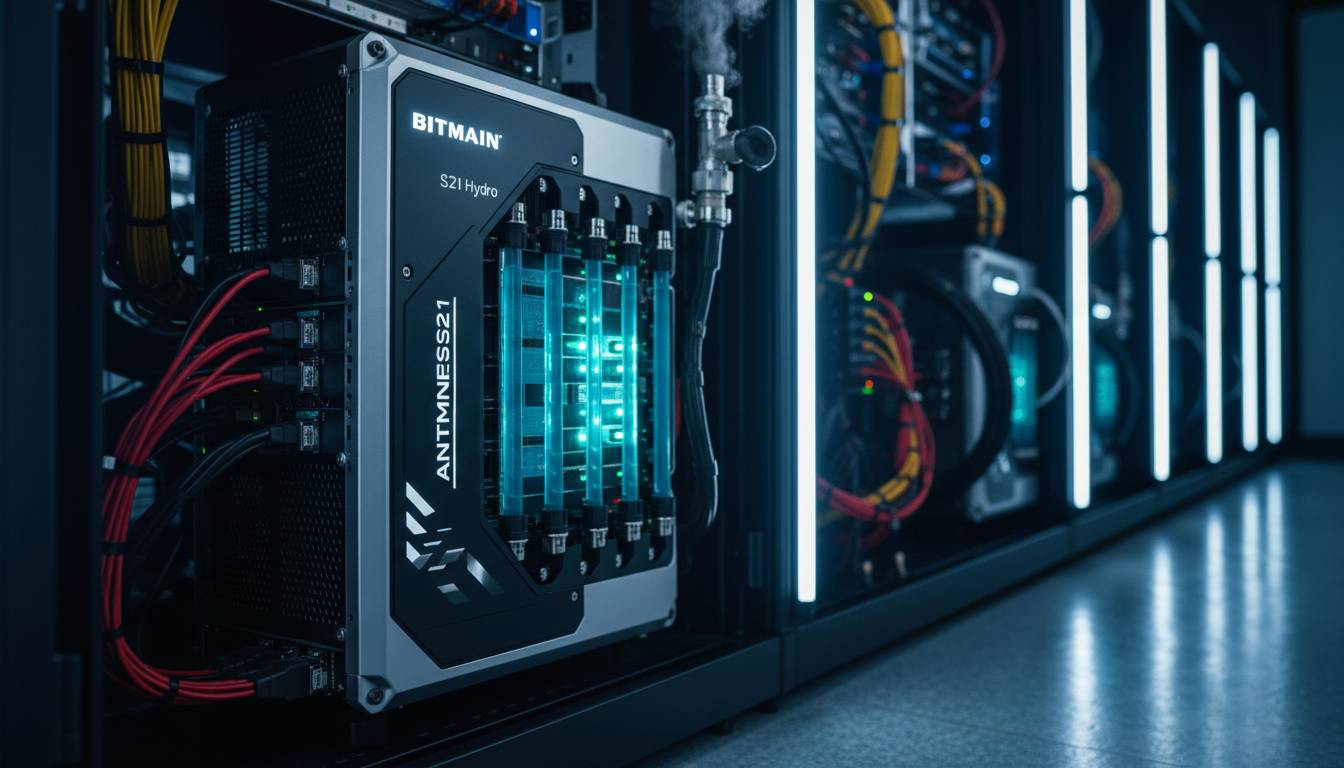
Bitmain Antminer S21 Pro is the new flagship. It does around 335 TH/s while pulling about 3,010 watts. That’s roughly 9 J/TH efficiency—which is good, not revolutionary. If you have cheap power (under $0.05/kWh), this machine will print money. If you’re paying residential rates, it’ll still probably make money, but your margins are thinner than they look on paper.
The S21 Pro costs more than older models, obviously. Whether the premium is worth it depends on what you expect from the market.
Bitmain S19 XP Hyd. is the water-cooled version that hits about 255 TH/s. These showed up in 2022 and have a track record now. They’re reliable, parts are available, and you can find used ones at reasonable prices. If the S21 Pro is out of budget, the S19 series is still a solid choice—just understand you’re not getting the newest efficiency gains.
MicroBT Whatsminer M50S competes directly with Bitmain’s offerings. Around 126 TH/s with higher power consumption—honestly, the numbers don’t look as good on paper as the S21. But MicroBT sometimes undercuts Bitmain on pricing, so it’s worth checking what actually costs less in your region.
Canaan makes Avalon miners too. They work fine. They just don’t have the market share or support network of Bitmain or MicroBT.
Best GPU Mining Rigs for 2024
GPU mining changed completely when Ethereum switched to proof-of-stake. That eliminated the single biggest use case for GPU mining. But there’s still life in it if you pick the right coins.
NVIDIA RTX 4090 is the king of consumer GPUs for mining. It hashes well on memory-intensive algorithms and can switch between different coins based on what’s profitable. The downside is the price tag—you’re looking at $1,600+ per card, so a rig with multiple 4090s gets expensive fast.
AMD RX 7900 XTX is Team Red’s answer. Sometimes it beats NVIDIA on specific algorithms. Historically, AMD cards have had advantages in certain mining scenarios, so they deserve a place in a diversified operation. Pricing has normalized since the 2021-2022 madness, which is a relief.
Building a GPU rig isn’t just about the graphics cards. You need a motherboard that can hold multiple cards, enough PSU wattage to power everything, risers, cooling, and a case or frame. These extras add up—don’t budget for just the GPUs or you’ll get caught short.
Most Profitable Mining Hardware: ROI Analysis
Here’s the thing nobody talks about enough: the most profitable hardware depends entirely on your situation.
If you’re running a commercial facility with industrial electricity ($0.04-0.05/kWh), the newest ASICs make sense. You can afford the premium pricing, you have the scale to make ROI work, and five-year-old machines still run fine with maintenance.
If you’re mining at home on residential power ($0.10-0.15/kWh in most of the US), you need to think carefully. That S21 Pro might not make sense when your electricity bill arrives. GPU mining on alternative coins might actually be more profitable because the competition is lower than Bitcoin’s hashrate arms race.
One thing people forget: ASICs hold value in the secondary market better than GPUs, mostly because GPUs have other uses and ASICs don’t. But ASIC resale value depends entirely on whether the algorithm they mine is still profitable. That’s a risk factor worth remembering.
Essential Considerations Before Purchasing Mining Hardware
Beyond the specs, there are practical issues that will make or break your operation.
Electricity is the make-or-break factor. I can’t stress this enough. Calculate your actual cost per kilowatt-hour, including all fees and demand charges. If you’re above $0.08/kWh, Bitcoin ASICs might not make sense for you.
Noise is a real problem. ASICs are loud—80+ decibels. That’s like a shop vacuum running constantly. You can’t put these in a spare bedroom without annoying everyone in the house. Think about where you’ll run them and what that means for your family or neighbors.
Heat is the other problem. All that electricity becomes heat. In summer, your mining room might add 20 degrees to your house. In winter, that’s a feature, not a bug. Plan accordingly.
Maintenance will happen. Fans fail. Cooling systems clog. You need either technical skills to fix these yourself or budget for a service provider. Manufacturer support varies a lot by region—check what’s available before you buy something you can’t get fixed locally.
Regulatory risk is real. Some countries are hostile to mining. Some US states have banned it. Some cities have noise ordinances that could affect your setup. Know the rules before you spend money on hardware that might become illegal to run.
Frequently Asked Questions
What is the most profitable crypto mining hardware in 2024?
It depends on your electricity. Under $0.05/kWh? Antminer S21 Pro. Higher costs? Maybe GPU mining on altcoins, or maybe don’t mine at all until prices change.
How much does a good crypto mining rig cost in 2024?
ASICs: $2,000-5,000 depending on model and availability. GPU rigs: $3,000-10,000+ for something competitive. You can spend more if you want to go bigger.
Is crypto mining still profitable in 2024?
Yes, but it’s harder than it was. The halving and difficulty increases squeezed margins. Efficient hardware and cheap electricity are non-negotiable now.
How long does it take to ROI on mining hardware?
Best case with cheap power and a good hardware buy: 12-18 months. More realistically, 18-30 months if things go well. Cryptocurrency price swings can make this much longer or shorter.
Should I start with ASIC or GPU mining?
ASICs are more efficient for specific coins but cost more and are less flexible. GPUs cost less to start, let you switch between coins, but are less efficient for Bitcoin. Think about what you actually want to mine.
Conclusion
The 2024 mining market has good hardware available if you’re willing to do the math. Don’t just buy whatever review says is “best”—buy whatever is best for your specific situation. Your electricity rate, your budget, your technical skills, and your risk tolerance all matter.
The people who make money in mining aren’t the ones chasing the newest hardware. They’re the ones who understand their costs, manage their risk, and adapt when the market changes. The hardware is just a tool—the math is what separates profit from loss.