
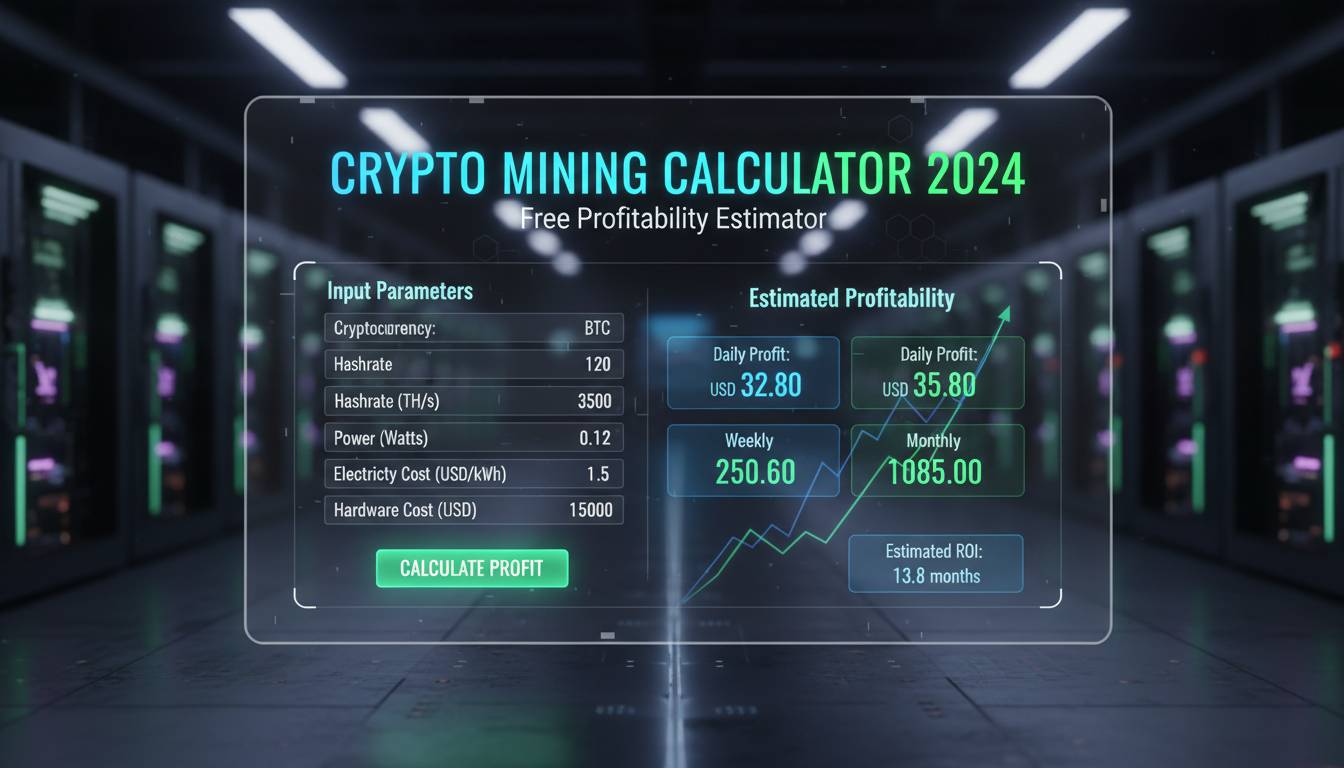
Crypto mining calculators help you figure out whether your operation will make money. That’s the whole point. These tools take your hardware specs, electricity costs, and current market data, then spit out estimated profits. Simple enough in concept, but the actual math gets messy quickly.
This guide covers how these calculators work, what variables actually matter, and what you should think about before dropping thousands on mining hardware.
Profitability is just revenue minus costs. Your revenue comes from block rewards and transaction fees. Your costs are electricity, hardware, pool fees, and whatever maintenance you need to keep things running.
The tricky part is that every variable here moves constantly. Crypto prices swing wild. Network difficulty adjusts every couple weeks. Your electricity rate might stay steady, but everything else won’t.
Most people getting into mining underestimate how much electricity matters. We’re talking 60-80% of your ongoing costs right there. A hobbyist in California paying 20 cents per kilowatt-hour is in a completely different situation than someone running operations in Texas or hydro-rich Quebec.
Professional mining operations have dominated Bitcoin for years now. They’re not going anywhere, and they have capital to burn on efficient hardware and cheap power.
How These Calculators Actually Work
You input your hashrate (how fast your hardware mines), power consumption in watts, electricity cost per kilowatt-hour, and pool fees if you’re joining one. The calculator pulls current data on the coin’s price, network difficulty, and block reward.
From there it projects daily, weekly, monthly, and yearly earnings. Most also show a break-even point so you know how long until you’ve paid off the hardware.
WhatToMine, CoinWarz, CryptoCompare, and NiceHash all offer calculators covering various coins. They don’t all calculate things identically, so comparing across platforms is worth your time.
Here’s the thing: these are estimates. They’re based on current conditions, and conditions change. A one-year projection is basically a guess. Even monthly projections have plenty of uncertainty baked in.
Variables That Actually Affect Your Profits
Network difficulty determines how much hashrate you need to find blocks at a consistent rate. When more miners join, difficulty goes up, and your slice of the reward gets smaller. Bitcoin adjusts difficulty roughly every two weeks.
Coin price matters more than anything else for revenue. Your costs are in dollars, your revenue is in crypto. If the price crashes, you might go from profitable to underwater fast. If it mooned, great—but don’t count on that when doing your math.
Block rewards get cut in half roughly every four years for Bitcoin. The April 2024 halving dropped rewards from 6.25 BTC to 3.125 BTC per block. That’s a huge shift in revenue.
Electricity costs vary enormously. Under 5 cents per kWh in some areas with abundant hydro or wind. Over 20 cents in places with expensive grids. For identical hardware, that difference means profit versus loss.
Hardware efficiency improves with each generation. Modern ASIC miners use under 20 joules per terahash. Older machines might need 100+ J/TH. That efficiency difference directly impacts your operating costs.
Electricity: The Make-or-Break Factor
I’ve said it already, but it bears repeating: electricity is usually the biggest expense. If you’re paying 15 cents per kWh in the US residential, you’re already at a disadvantage compared to industrial operations that negotiate rates.
Power consumption for a serious ASIC runs 3,000-4,000 watts. GPU rigs use less but also hash less. The numbers from manufacturers are theoretical peaks—your actual usage under load will vary.
Location is the big lever here. Some miners literally set up in places with cheap hydro. Others negotiate power contracts. If you’re stuck paying residential rates, your margin is thin before you even start.
Cooling adds to your power bill too. All that heat has to go somewhere.
Hardware: Hashrate and Efficiency
Hashrate is your computational speed. More hashes per second means more chances to find blocks. Simple enough.
ASIC miners are specialized beasts. They’re built for one specific algorithm and nothing else. Top machines do over 200 terahashes per second, but they’ll cost you $5,000-10,000+ depending on the model and availability.
GPU rigs are more flexible. You can switch between coins by changing software. But they don’t match ASIC efficiency for any given algorithm.
Efficiency measured in joules per terahash tells you how much energy each hash costs. Lower is better. Modern ASICs getting under 20 J/TH are dramatically better than machines from even a few years ago.
Whether to buy new hardware depends on your situation. Newer machines cost more upfront but use less power. Sometimes it’s cheaper to run older equipment into the ground than upgrade.
Using These Tools Without Getting Burned
Calculator outputs are only as good as your inputs. Don’t guess on hashrate—look up real benchmarks for your specific hardware. Power consumption should be measured if possible, not just assumed from the box.
Long-term projections are unreliable. Cryptocurrency price is the biggest variable, and nobody can predict it. If someone tells you exactly what you’ll earn in a year, they’re lying.
Using multiple calculators helps catch errors. Different sites might pull different data or use slightly different formulas.
The 2024 Reality Check
Bitcoin’s hashrate keeps climbing. More competition means harder mining. The 2024 halving cut block rewards in half. Some miners quit; others got more efficient. Price has recovered somewhat, but the economics are tighter than pre-halving.
Regulation is a factor in some regions. Some countries have cracked down. Some states in the US have imposed restrictions. Worth thinking about if you’re planning anything serious.
Alternative coins sometimes offer better margins than Bitcoin, especially if difficulty hasn’t caught up yet. Kaspa and some newer projects have been profitable for certain setups. But this changes fast.
Common Questions
How do you calculate mining profitability?
Revenue minus costs. Multiply your hashrate by your share of the network hashrate, multiply by the block reward and coin price, subtract electricity and fees. Or just use a calculator.
Which crypto is most profitable?
Depends on the day, your hardware, and your electricity costs. Bitcoin is most valuable but also most competitive. Smaller coins sometimes offer better margins for specific setups. Check multiple calculators to compare.
Is mining still profitable in 2024?
Sometimes. If you have cheap electricity and efficient hardware, yes. If you’re paying retail power rates with old equipment, probably not.
How long to mine one Bitcoin?
Solo mining at home with typical hardware: you’d be waiting many years on average. That’s why people join pools—smaller consistent payouts instead of a lottery ticket.
What makes profitability change?
Price, difficulty, electricity rates. Those three things. Hardware improvements matter too if you’re deciding whether to upgrade.
Should I check a calculator before buying hardware?
Yes. Definitely. Input your real electricity cost and the actual specs of hardware you’re considering. If the numbers don’t work, don’t buy it.