
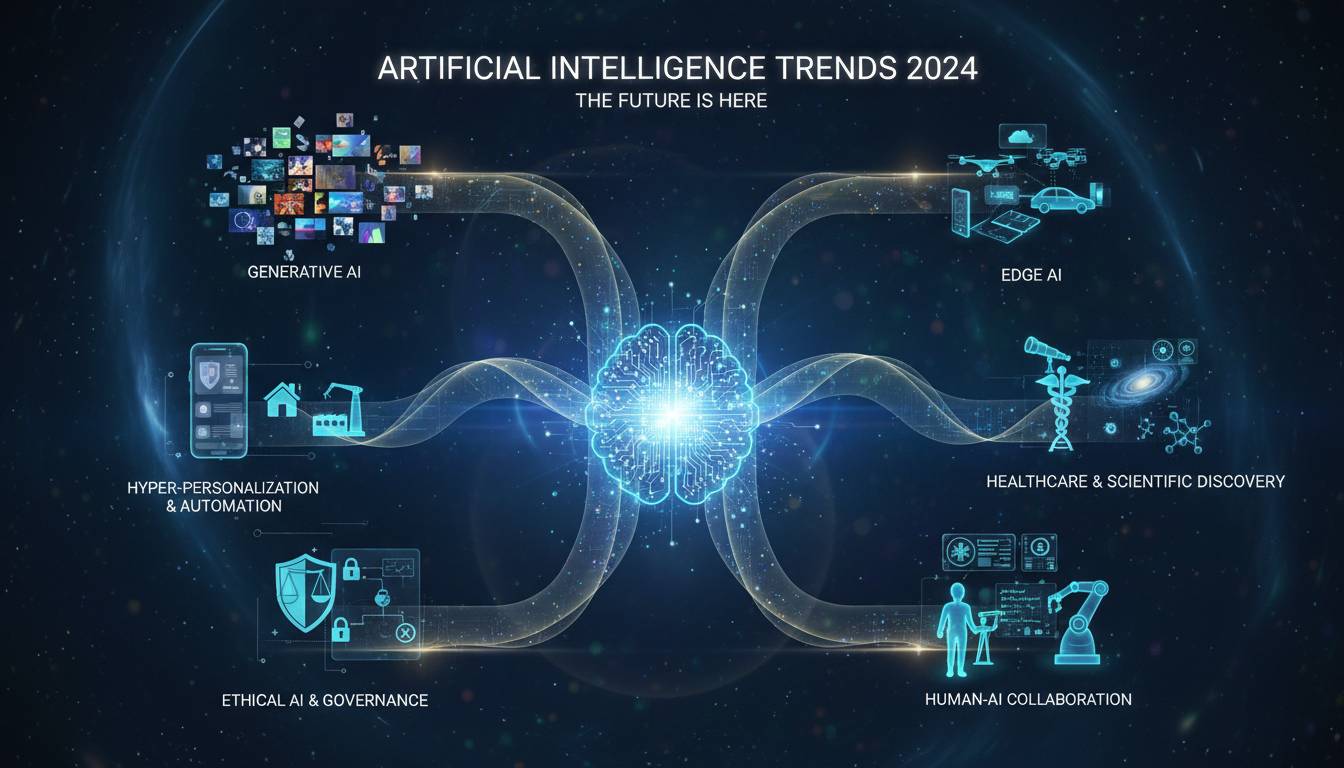
Artificial intelligence moved in 2024 from something companies experimented with to something they actually rely on. This shift matters for businesses figuring out how to compete, for workers wondering what their jobs will look like, and for regulators trying to keep pace with technology that’s advancing faster than policy can catch up.
The trends worth watching aren’t all equally significant—some represent real change, while others are more noise than substance. Here’s what’s actually happening.
Generative AI Gets Real
The biggest story in 2024 isn’t that generative AI exists—it’s that companies figured out how to use it productively. Large language models moved from proof-of-concept demos to actual customer service workflows, content pipelines, and data analysis tasks.
The numbers tell the story. Industry analysts at Gartner and McKinsey report that enterprise adoption jumped from under 20% at the start of 2024 to over 65% by mid-year among large companies. That’s not because the technology suddenly got better—it’s because businesses stopped asking “can we use this?” and started asking “how do we make money from this?”
What changed was accessibility. No-code platforms and ready-made models meant companies without AI teams could finally participate. A mid-sized logistics firm or regional bank could tap into capabilities that, a year earlier, required either a research lab or a massive IT budget.
Enterprise AI: The Integration Problem
Every company now says they have an AI strategy. What actually distinguishes winners from also-rans is execution.
The shift in 2024 was from isolated pilot projects to company-wide deployment. Financial services companies use AI for fraud detection and to personalize what customers see. Hospitals added AI diagnostic tools that help radiologists catch things they might miss. Manufacturers deployed predictive maintenance to avoid expensive downtime.
But here’s what CTOs actually talk about privately: the bottleneck isn’t the AI models. It’s their data. Companies with clean, accessible, well-organized data are running circles around those still trying to untangle their information infrastructure. You can buy the best AI model available, but if your data is a mess, your results will be too.
Governance Becomes Non-Negotiable
AI got powerful enough in 2024 that ignoring the ethics question became irresponsible. Every major company now has some form of AI governance—ethics boards, review processes, documentation requirements. This wasn’t purely altruistic. The EU’s AI Act created real compliance burdens for companies operating in Europe. In the US, a patchwork of executive orders and agency guidance meant companies had to pay attention or risk legal trouble.
But the business case went beyond compliance. Companies with solid governance frameworks reported something concrete: easier talent acquisition, stronger customer trust, fewer PR disasters. Being able to explain how your AI made a decision became a competitive advantage, especially in regulated industries.
Work Is Changing—But Not How Fearmongers Predicted
The automation narrative in 2024 settled into something more nuanced than “robots taking all the jobs.” Instead, AI became a tool that makes certain workers more effective.
Customer service reps with AI assistants handle twice the volume, with the AI flagging routine issues and passing complex problems to humans. Software developers use coding assistants that catch bugs and suggest improvements. The pattern across industries: AI handles the repetitive parts, humans focus on what requires judgment, creativity, or empathy.
The labor market shifted accordingly. Data scientists and machine learning engineers remained in high demand with compensation packages to match. But companies also invested heavily in reskilling—teaching existing employees how to work alongside AI rather than being replaced by it.
Economists who’ve studied previous technological transitions note this pattern: new jobs emerge to build and maintain the systems, while existing jobs evolve to incorporate the tools. The net effect on employment tends to be positive over time, even if the transition is bumpy.
Healthcare Sees Real Results
Healthcare deserves special attention because 2024 was the year AI diagnostics actually entered clinical practice, not just research papers.
AI systems for reading X-rays, CT scans, and pathology slides matched or exceeded human specialists in specific tasks. This doesn’t mean AI is replacing doctors—it means doctors with AI are outperforming doctors without it. The technology handles the screening work, flagging abnormalities for human review.
Drug discovery accelerated meaningfully. Pharmaceutical companies using AI to analyze molecular structures reported cutting discovery timelines by months or years. A process that used to take a decade can now happen in a fraction of the time, potentially bringing treatments to patients faster.
The FDA and other regulators developed new frameworks for approving AI medical devices that learn and improve over time—a necessary adaptation for technology that doesn’t stay static.
What Actually Matters
If you strip away the hype, a few things are clear about where AI stands in 2024:
The technology works. Generative AI isn’t vaporware—companies are using it to deliver real business value.
Data infrastructure determines success more than model choice. The companies pulling ahead invested in their data years ago.
Governance isn’t optional. Regulatory momentum is building globally, and companies that treat AI ethics as an afterthought will face consequences.
Workforce strategy matters as much as technology strategy. AI implementation fails when companies forget the humans involved.
The organizations best positioned for the years ahead are those building comprehensively—technology, data, talent, and governance together—rather than chasing the latest model or headline.
Conclusion
AI in 2024 isn’t a future possibility. It’s a present reality reshaping how businesses operate, how healthcare gets delivered, and how work gets done. The companies thriving aren’t necessarily the ones with the most advanced technology. They’re the ones who’ve thought systematically about implementation, data, governance, and workforce.
For anyone planning for the next few years, the key insight is straightforward: the AI transformation isn’t coming. It’s here. The question is whether you’re building the capabilities to navigate it effectively.
Frequently Asked Questions
What’s driving AI adoption in 2024?
The main drivers are generative AI becoming usable by non-technical teams, competitive pressure as early adopters show results, and regulatory frameworks finally taking shape that give companies confidence about compliance requirements.
How are businesses actually using generative AI?
Common applications include customer service automation, content generation for marketing and documentation, coding assistance for developers, and data analysis. The shift in 2024 was from experimental pilots to production systems generating measurable returns.
What regulations are companies dealing with?
The EU AI Act creates the most comprehensive framework, with risk-based requirements affecting companies in European markets. US companies navigate a mix of executive orders, agency-specific guidance (especially in healthcare and financial services), and emerging state-level laws. Compliance has become a significant operational concern.
Will AI replace jobs?
The evidence so far suggests AI augments human workers more than replacing them. Demand for AI-related skills has increased substantially, while companies invest in reskilling programs for existing employees. The net employment effect appears positive over time, though specific roles and industries vary.
Where is AI adoption furthest along?
Financial services, healthcare, and manufacturing lead in production deployments. Technology companies obviously invest heavily, but the most dramatic 2024 gains were in traditional industries applying AI to operational efficiency rather than building new AI products.