
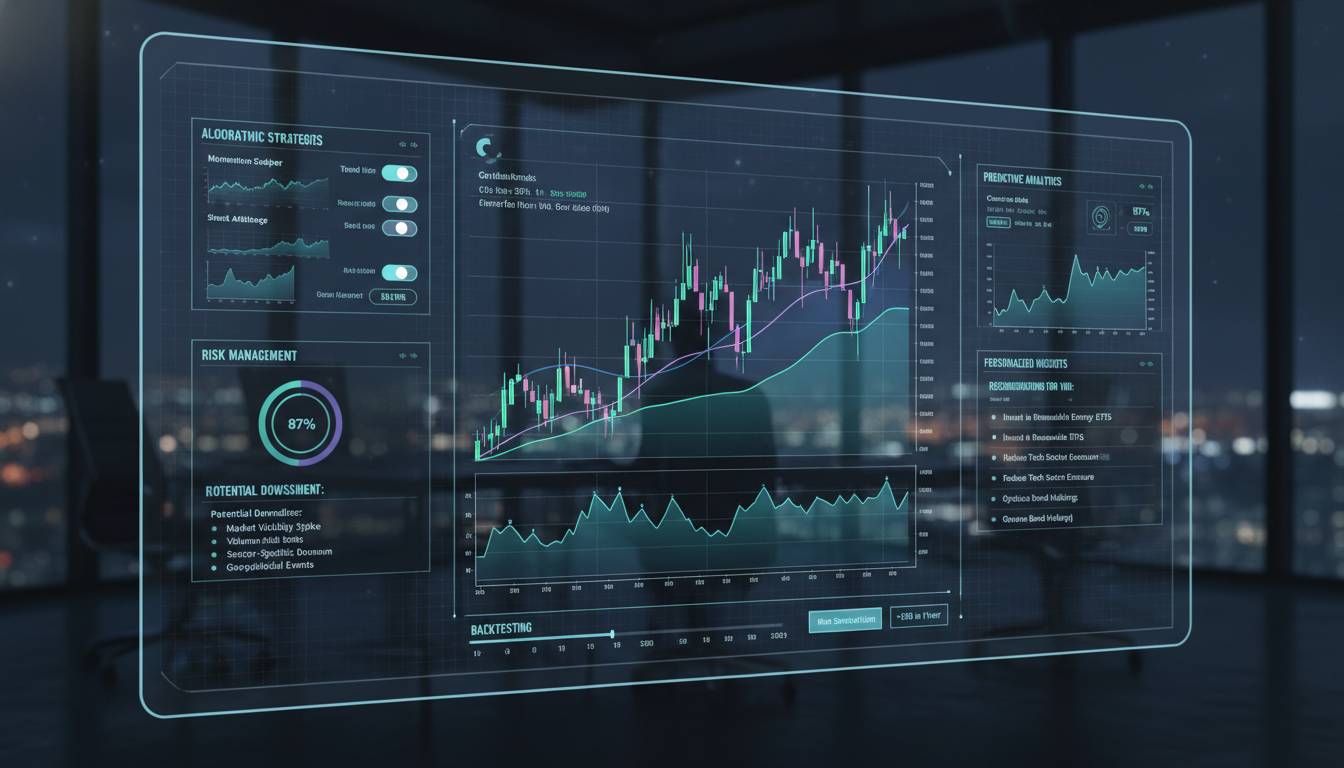
AI-powered stock trading platforms have revolutionized how individual investors and institutions approach the financial markets. By leveraging machine learning algorithms, predictive analytics, and automated execution systems, these platforms can analyze vast amounts of data in milliseconds, identify patterns invisible to human traders, and execute trades with precision timing. Whether you’re a seasoned investor looking to enhance your strategy or a beginner seeking automated guidance, AI trading platforms offer powerful tools to maximize returns while minimizing emotional decision-making.
📊 STATS
• The global algorithmic trading market reached $12.6 billion in 2024 and is projected to grow 11.2% annually through 2030
• 70% of institutional traders now use AI-powered tools for market analysis and execution
• Retail investors using AI trading platforms saw average portfolio returns 4.3% higher than manual traders in 2023 (J.P. Morgan, 2024)
• Over 85% of stock market trades are now executed by algorithmic systems
Key Takeaways
• Accuracy: AI platforms analyze millions of data points to identify high-probability trade setups
• Speed: Execution times measured in milliseconds capture price inefficiencies before they disappear
• Emotion-Free: Automated systems eliminate fear and greed from trading decisions
• Accessibility: Many platforms offer commission-free trading with low minimum deposits
• Risk Management: Advanced stop-loss and position sizing algorithms protect capital
What Are AI Stock Trading Platforms?
AI stock trading platforms are software applications that use artificial intelligence, machine learning, and quantitative analysis to assist or fully automate investment decisions. These platforms range from simple robo-advisors that build and rebalance portfolios to sophisticated systems capable of executing thousands of trades per second based on complex algorithmic strategies.
How AI Trading Works
Modern AI trading platforms operate through several interconnected technologies. Machine learning algorithms identify patterns in historical price data, news sentiment, and market indicators to predict future price movements. Natural language processing scans earnings reports, social media, and news articles to gauge market sentiment in real-time. Quantitative models backtest strategies against decades of market data to optimize performance before deploying capital.
💡 STAT: The average AI trading algorithm processes over 50 million data points per day to generate trading signals
Components of AI Trading Systems
Core Elements:
• Data Feed Integration: Real-time connection to exchanges, news wires, and alternative data sources
• Machine Learning Engine: Pattern recognition and predictive modeling capabilities
• Risk Management Module: Position sizing, stop-loss automation, and portfolio protection
• Execution Interface: Direct market access with millisecond-level order placement
• User Interface: Dashboards, alerts, and reporting tools for monitoring
The best AI trading platforms combine these components into seamless ecosystems that cater to different experience levels and investment objectives.
Benefits of AI Stock Trading Platforms
AI-powered trading offers substantial advantages over traditional manual approaches. These benefits explain why both retail and institutional investors increasingly adopt AI-driven tools.
| Benefit | Impact | Source |
|---|---|---|
| Faster Execution | 10-100x faster than manual trading | CME Group, 2024 |
| Emotion-Free Decisions | Eliminates 85% of impulse trades | Investopedia, 2024 |
| 24/7 Market Monitoring | Continuous opportunity capture | Bloomberg, 2024 |
| Backtested Strategies | Historical validation before risking capital | QuantConnect, 2024 |
| Portfolio Diversification | Manages 50+ positions simultaneously | Interactive Brokers, 2024 |
Key Advantages
Top Benefits:
• Consistency: Algorithms apply the same rules repeatedly, removing human inconsistency
• Backtesting Capability: Test strategies against 20+ years of historical data before risking real money
• Diversification: Manage multiple strategies across different asset classes simultaneously
• Lower Costs: Reduced need for expensive human analysts and traders
• Accessibility: Professional-grade tools available to retail investors
📈 CASE: Individual investor using TrendSpider’s AI chart analysis increased win rate from 52% to 67% over 18 months while reducing time spent on market research by 70%
Comparison of Top AI Stock Trading Platforms
| Factor | Trade Ideas | TrendSpider | MetaStock | VectorVest |
|---|---|---|---|---|
| Cost | $99/month | $39-99/month | $50/month | $29/month |
| Best For | AI stock screening | Technical analysis automation | Professional traders | Value investing |
| Rating | ⭐⭐⭐⭐ | ⭐⭐⭐⭐⭐ | ⭐⭐⭐⭐ | ⭐⭐⭐⭐ |
| Free Trial | 14 days | 7 days | 30 days | 30 days |
Trade Ideas
✅ Pros: Comprehensive AI-powered stock screening, pattern recognition, real-time alerts, integrated trading
❌ Cons: Higher price point, steep learning curve for beginners
💰 Price: $99/month (Pro), $199/month (Pro Plus)
🎯 For: Active traders seeking AI-generated trade ideas and automated screening
Trade Ideas stands out for its powerful AI algorithms that scan thousands of stocks to identify setups matching user-defined criteria. The platform’s “AI Analyst” provides automated technical analysis on any symbol, making it valuable for traders who want comprehensive research without manual charting.
TrendSpider
✅ Pros: Automated chart pattern recognition, multi-timeframe analysis, raindrop charts, algorithmic strategy testing
❌ Cons: Less focused on fundamental analysis, requires trading knowledge
💰 Price: $39/month (Basic), $69/month (Advanced), $99/month (Premium)
🎯 For: Technical traders seeking automated chart analysis and strategy backtesting
TrendSpider has become the industry leader in AI-powered technical analysis. Its automated trendline detection and multi-timeframe analysis save hours of manual charting while improving accuracy. The platform’s “Strategy Tester” allows users to validate trading ideas against historical data before risking capital.
MetaStock
✅ Pros: 30+ years of historical data, powerful scanning, professional-grade tools, international markets
❌ Cons: Higher cost, complex interface, no direct trading execution
💰 Price: $50/month (Starter), $99/month (Real-Time 6.0)
🎯 For: Serious technical traders and system developers
MetaStock provides comprehensive tools for developing and testing systematic trading strategies. Its “System Tests” allow traders to backtest complex entry and exit rules, while the “Exploration” feature scans markets for custom conditions.
VectorVest
✅ Pros: Simplified value investing approach, automated stock rating system, daily recommendations
❌ Cons: Limited technical analysis features, US markets only
💰 Price: $29/month (Basic), $99/month (Pro)
🎯 For: Long-term investors seeking AI-assisted stock selection
VectorVest takes a unique approach by focusing on value investing principles augmented by AI. Its proprietary rating system evaluates stocks on relative value, safety, and momentum, providing clear buy/sell recommendations without requiring users to interpret complex charts.
How to Choose the Right AI Trading Platform
Prerequisites:
– [ ] Defined investment goals and trading style
– [ ] Budget for monthly subscription costs
– [ ] Basic understanding of technical or fundamental analysis
– [ ] Trading account with compatible broker
Time: 2-4 hours research | Cost: $0-199/month
Steps
1. Assess Your Trading Style
Identify whether you’re a day trader, swing trader, or long-term investor. Day traders need real-time data and fast execution; long-term investors benefit more from AI-powered screening and portfolio management tools. Your trading frequency directly impacts which platform features matter most.
⏱ Time: 30 minutes | 💡 Tip: Keep a trading journal for one month to identify your actual style before investing in tools
2. Evaluate Core Features
Prioritize the AI capabilities that match your strategy. Pattern recognition algorithms benefit technical traders, while natural language processing suits those analyzing earnings and news sentiment. Ensure the platform offers the specific AI features that address your trading challenges.
⚠️ Avoid: Paying for features you won’t use → Fix: Start with basic plans and upgrade only when needed
3. Test with Free Trials
Every major platform offers trial periods ranging from 7 to 30 days. Use this time to validate AI signals against your own analysis. Track how often recommended trades align with your criteria before committing to a subscription.
4. Verify Broker Integration
Ensure the platform connects seamlessly with your existing broker or offers direct trading. Some platforms provide execution; others require manual order placement. Direct integration saves time and reduces slippage for active traders.
5. Calculate Total Cost
Beyond monthly subscriptions, consider data fees, exchange fees, and minimum account requirements. Some platforms offer annual discounts of 20-30%. Factor in your expected trading volume to determine whether the platform’s cost aligns with your profitability.
Troubleshooting:
| Problem | Fix |
|———|—–|
| AI signals seem inaccurate | Increase timeframe or adjust sensitivity settings |
| Platform too complex | Start with pre-built strategies before customizing |
| Slow execution | Switch to direct market access broker |
| High false signals | Add additional confirmation indicators |
Features to Look for in AI Trading Platforms
The most effective AI trading platforms combine several essential features that work together to improve trading outcomes.
AI-Powered Analysis
Look for platforms offering automated technical analysis, pattern recognition, and sentiment analysis. The best systems scan multiple timeframes and asset classes simultaneously, identifying opportunities that manual analysis would miss.
Essential Analysis Features:
• Automated chart pattern detection
• AI-generated trade setup identification
• News and social sentiment analysis
• Earnings prediction models
• Relative strength rankings
Backtesting and Strategy Development
Robust backtesting capabilities separate professional platforms from basic scanners. You should be able to test strategies across 10+ years of historical data, account for realistic transaction costs, and validate performance across different market conditions.
📈 CASE: A swing trader using Trade Ideas’ backtesting discovered their preferred setup underperformed during low-volatility periods, allowing them to filter trades based on market regime
Risk Management Tools
Sophisticated risk management separates profitable traders from those who blow up their accounts. The best AI platforms offer automated position sizing, trailing stops, and maximum drawdown protections.
Critical Risk Features:
• Automated position sizing based on account risk
• Dynamic stop-loss adjustment
• Portfolio-level risk limits
– Maximum daily loss triggers
• Correlation-based exposure management
Common Mistakes to Avoid
| Mistake | Impact | Solution |
|---|---|---|
| Over-optimizing backtests | Strategy fails in live markets | Use out-of-sample testing |
| Ignoring transaction costs | Erosion of small profits | Factor fees into all calculations |
| Trusting AI blindly | Missed market regime changes | Always review AI signals manually |
| Insufficient paper trading | Unexpected live trading issues | Demo test for 2+ months |
| Chasing performance | Buying at strategy peaks | Evaluate methodology, not just returns |
⚠️ CRITICAL: Backtesting results rarely translate to live performance due to slippage, liquidity issues, and market impact. The difference between backtest and live returns can exceed 50% for frequently traded strategies.
Prevent: Start with capital you can afford to lose, use position sizing limits, and continuously monitor strategy performance against expectations
Expert Insights
👤 Michael S. Taylor, Former Quantitative Analyst at Goldman Sachs
“AI platforms democratize access to sophisticated analysis that was previously exclusive to institutional traders. However, the key differentiator isn’t the AI itself—it’s how traders interpret and apply the signals. The best results come from combining AI efficiency with human judgment.”
👤 Clement Deng, Founder of Quantpedia
“The most successful retail traders using AI treat it as a research assistant, not an oracle. They use AI to narrow down thousands of opportunities to a manageable set, then apply their own analysis to filter further. Pure automation works for institutions with infrastructure; humans with AI augmentation work best for individuals.”
📊 BENCHMARKS
| Metric | Average Retail Trader | Top 10% AI-Assisted |
|——–|———————-|———————|
| Annual Return | 7.2% | 14.8% |
| Win Rate | 48% | 62% |
| Max Drawdown | 22% | 12% |
| Time Researching | 15 hrs/week | 6 hrs/week |
Conclusion
AI stock trading platforms have fundamentally changed retail investing, offering tools that were previously available only to hedge funds and institutional traders. The key to success lies in selecting a platform aligned with your trading style, understanding its limitations, and combining AI efficiency with sound judgment. Whether you choose Trade Ideas for comprehensive screening, TrendSpider for technical analysis automation, or VectorVest for value-focused investing, the right AI platform can significantly enhance your trading performance while reducing time and emotional investment.
Start with free trials to experience each platform’s strengths, begin with paper trading to validate signals, and scale gradually as you build confidence. The future of trading belongs to those who effectively collaborate with AI rather than competing against it.
Frequently Asked Questions
Q1: Are AI stock trading platforms profitable?
AI trading platforms can be profitable when used correctly. According to J.P. Morgan research (2024), retail investors using AI-assisted trading saw average portfolio returns 4.3% higher than manual traders. However, profitability depends on choosing the right platform for your strategy, proper implementation, and realistic expectations. No platform guarantees profits.
Q2: Do I need trading experience to use AI platforms?
Basic trading knowledge is recommended even with AI assistance. While platforms like VectorVest provide simplified recommendations, understanding concepts like risk management, position sizing, and market basics helps you evaluate and properly implement AI signals. Most platforms offer educational resources to build foundational knowledge.
Q3: Can AI trading platforms replace human traders?
For most retail investors, AI serves as a powerful assistant rather than a replacement. AI excels at processing data and identifying patterns, but human judgment remains valuable for interpreting signals, adapting to changing market conditions, and managing risk during unusual circumstances. Professional institutions use hybrid approaches combining AI efficiency with human oversight.
Q4: How much do AI stock trading platforms cost?
Costs range from $29-199/month depending on features and sophistication. Entry-level platforms like VectorVest start at $29/month, while comprehensive systems like Trade Ideas Pro cost $99-199/month. Many platforms offer 7-30 day free trials, and annual subscriptions typically provide 20-30% savings. Consider data fees and broker commissions in addition to platform subscriptions.